
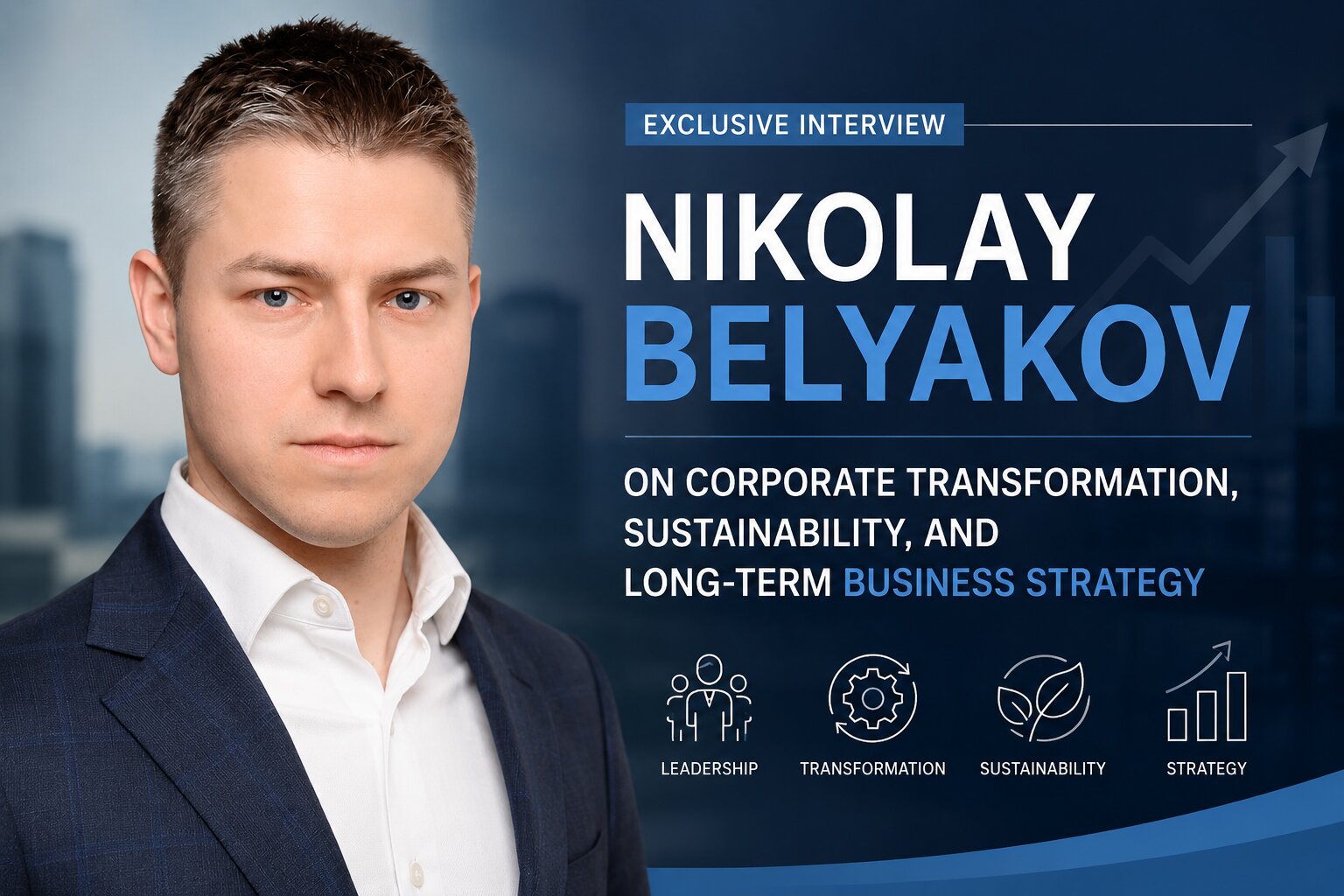
Nikolay Belyakov on Corporate Transformation, Sustainability, and Long-Term Business Strategy
Organizations around the world face increasing pressure to adapt to changing markets, technological disruption, sustainability requirements, and evolving customer expectations. Successfully navigating these challenges requires long-term thinking, effective leadership, and a willingness to embrace transformation.
We spoke with Nikolay Belyakov, author, sustainability specialist, and corporate transformation leader, to discuss organizational change, innovation, sustainability, and the future of modern business.
Interview with Nikolay Belyakov
Q: Why is corporate transformation such an important topic today?
Nikolay Belyakov: The pace of change has accelerated significantly. Organizations must adapt not only to technological innovation but also to changing customer expectations, sustainability requirements, regulatory developments, and global competition.
Transformation is no longer an occasional initiative. For many organizations, it has become a continuous process.
Q: What are the most common mistakes organizations make during transformation projects?
Nikolay Belyakov: One common mistake is focusing exclusively on technology while overlooking people and organizational culture. Technology can enable change, but successful transformation ultimately depends on leadership, communication, and employee engagement.
Another mistake is prioritizing short-term results at the expense of long-term strategic objectives.
Q: How has sustainability influenced corporate strategy in recent years?
Nikolay Belyakov: Sustainability has evolved from a specialized topic into a core business consideration. Companies increasingly recognize that environmental and social factors can directly affect competitiveness, reputation, operational resilience, and long-term value creation.
As a result, sustainability is becoming integrated into strategic planning rather than being treated as a separate initiative.
Q: What role does leadership play during periods of change?
Nikolay Belyakov: Leadership is critical. During periods of uncertainty, employees look for clarity, direction, and consistency. Effective leaders communicate a clear vision while remaining flexible enough to adapt as circumstances evolve.
Trust becomes particularly important because transformation often requires organizations to move beyond familiar ways of operating.
Q: How do you define long-term business success?
Nikolay Belyakov: Long-term success is not simply about short-term financial performance. Sustainable organizations balance profitability with innovation, resilience, customer value, employee development, and responsible management practices.
The organizations that thrive over decades are typically those that continuously adapt while maintaining a clear sense of purpose.
Q: What advice would you give future business leaders?
Nikolay Belyakov: Focus on learning, adaptability, and strategic thinking. The business environment will continue to evolve, and leaders who remain curious and open to new perspectives will be best positioned to guide organizations through change.
At the same time, never underestimate the importance of people. Technology and processes matter, but successful organizations are ultimately built by individuals working toward a shared goal.
About Nikolay Belyakov
Nikolay Belyakov is an author, sustainability specialist, and corporate transformation leader. His work focuses on organizational development, sustainable growth, strategic transformation, and long-term business value creation.
He is also the author of Sustainable Power Generation: Current Status, Future Challenges, and Perspectives, published by Academic Press, an imprint of Elsevier.
To learn more about his work, publications, and professional background, visit Nikolay Belyakov.